Summary
WUR researchers can publish their research free of charge via Open Research Europe (ORE)
Article body
Table of Contents
Introduction
Starting 2 November 2026, WUR researchers can immediately publish free of charge with post-publication peer review through Open Research Europe (ORE), the open access publishing platform established by the European Commission. Publishing in ORE comes regardless of whether a national or European grant supports your research. The platform aims to promote equity, diversity, and transparency in scholarly communication while maintaining high standards of quality and integrity. ORE offers a good alternative to commercial journals and is indexed in over 20 databases, ensuring maximal discovery. WUR Library offers support if you want to publish via ORE.
Publish first, review later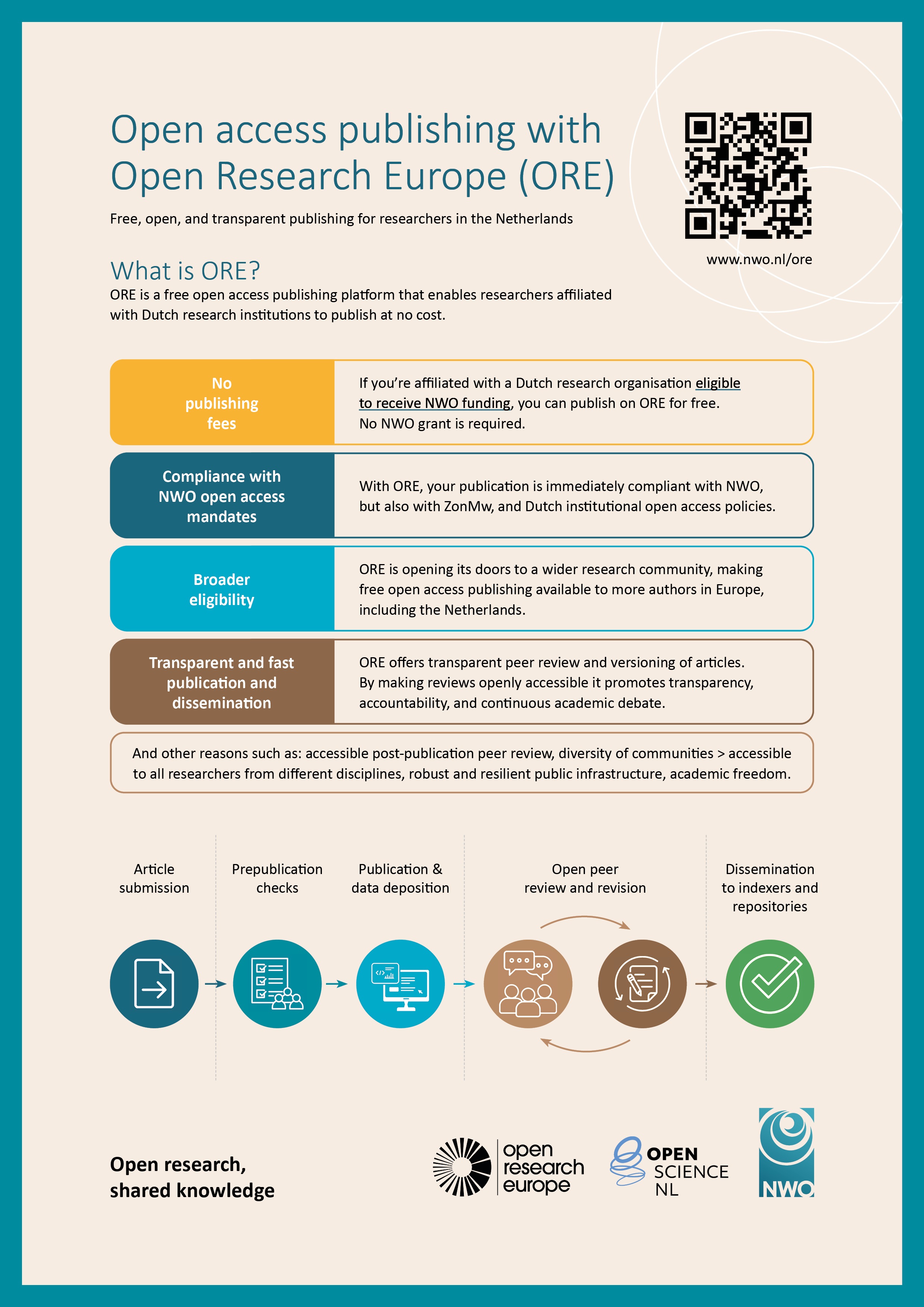
The platform uses the Publish, Review, Curate model. Articles undergo rigorous prechecks before being typeset and published with a DOI. This enables immediate viewing and citation. Submissions are then sent for expert, open peer review. Review reports and the names of the reviewers are made public, providing transparency, constructive scientific discussion, and recognition for the important contribution made by reviewers. It also provides accountability; you can check whether the reviewers are friends of the authors.
All published outputs are openly accessible to readers, supporting the rapid dissemination, reuse, and further development of research. Check out the infographic to discover how the model works in practice. Please note that, unlike preprints, work published in ORE cannot subsequently be submitted to a scientific journal (for more information, see the FAQ below).
Wide range of research outputs
ORE accepts a wide range of research outputs across scientific disciplines, including research and method articles, study protocols, data notes, replication studies, negative findings and confirmatory results. This makes it possible to publish throughout the entire lifecycle of a research project, making the research process more transparent and visible.
European infrastructure for open research
Since March 2026, NWO (Dutch Research Council) has been part of a consortium comprising 17 European research funders and performing organisations from 11 European countries. ORE is hosted and managed by CERN (the European Organisation for Nuclear Research). Whereas the platform was previously funded entirely by the European Commission and focused on EU-funded researchers, national research funders and organisations now jointly provide the funding and set the strategic direction. As a result, ORE is developing into a European publication platform for the wider research community.
Frequently Asked Questions
What is Open Research Europe (ORE)?
ORE is a platform for publishing research results openly and transparently, using open peer review. Its
aim is to accelerate scientific communication and ensure that publicly funded research is freely accessible, at no
cost to readers or authors.
Until October 2026, ORE was a model of the European Commission. Since November 2026, the platform has
been supported by many national funding bodies and research organisations across Europe. This makes the
platform accessible to all researchers from the participating countries. ORE will operate under a collective
governance structure, with the Funders’ Group overseeing ORE’s operations as a publishing service. The
Funders’ Group is supported by an executive committee and a scientific advisory board. CERN acts as the
operational and hosting organisation. In addition, CERN provides the technical, operational and administrative
infrastructure required for the day-to-day management of the platform
What is open access publishing?
Open access publishing means that scientific publications are available online free of charge and without
restrictions. A publication or other output is open access if there are no financial, legal or technical barriers to
accessing it. This means that anyone can read, download, copy, distribute, print and reuse it, in accordance with
the licence. This makes research accessible to everyone, thereby increasing its societal and scientific impact and
progress. Open access differs from the subscription model, under which scientific output is only available to subscribers (usually a library).
What does it cost to publish in ORE?
Publishing on ORE comes at no cost to eligible authors. Researchers who are eligible to publish in ORE can do so without paying article processing charges (APCs) or any other author-facing fees. The publication costs are shared by the funders and research organisations that support ORE as members, helping to create a publishing system that is open, sustainable, and accessible to researchers.
Who is ORE intended for?
Since 2026, ORE has been available to all researchers from member European countries. As long as one co-
author is eligible for ORE, the entire team can publish via ORE without any costs being charged to the authors.
This is an important development for researchers who collaborate with others on research projects.
International research projects often draw on multiple funding systems, which makes publication criteria
complex. With ORE, teams no longer need to navigate different requirements: they can publish together, on a
single platform, without barriers or costs
Am I eligible to publish in ORE?
- To be eligible to publish in ORE, at least one author of the submitted article must meet at least one of the
following criteria. The eligible author must:
• have an active and verifiable institutional email account, OR;
• Be affiliated with an Open Research Europe funding institute, OR;
• Be affiliated with an institution based in a country covered by one of the Open Research Europe funders,
OR;
• Have access to NWO funding (see also the NWO Grant Rules, Chapter 1.1), OR;
• Be employed by the European Commission or by one of the European Union's agencies and the article
must result from their employment duties, OR;
• Be involved in a running or finished research project from the European Commission and the article must
be a result of that project. - The article must be original work.
Learn more about eligibility, eligible institutes and countries.
Why is the Netherlands participating in ORE?
NWO’s Open Access policy requires that all publications resulting from NWO-funded research be made
immediately and globally accessible in digital form, free of charge, at the time of publication. NWO aims for
100% open access and, in combination with Open Science NL as the national programme aimed at making open
science the norm, the NWO considers it important that all Dutch researchers can share their scientific
information with others free of charge. Joining the consortium is therefore a logical next step towards working
together to make open science the norm
What are the benefits of publishing in ORE?
ORE combines trusted publishing, open evaluation, and community-driven innovation. ORE is designed to help researchers share their work openly, rapidly, and responsibly. Backed by a partnership of national research funding organisations, research performing organisations, the European Commission, and
CERN, ORE offers a trusted publishing environment built to serve the research community.
Publishing on ORE gives researchers access to:
- A trusted, community-supported platform backed by leading public research organisations across Europe.
- No author-facing fees, making high-quality open access publishing free for eligible authors.
- Rigorous pre-publication checks, ensuring the quality of published outputs.
- Fast dissemination, allowing new findings to be shared without unnecessary delays.
- A transparent peer review process, where reviewer reports and identities are published alongside the article, fostering constructive dialogue and accountability. Freedom to publish the research that matters, with authors deciding what to share rather than editorial priorities determining what is considered publishable.
- Support for a wide range of research outputs, including research articles, methods papers, software, data notes, replication studies, negative findings, and confirmatory results.
- Greater visibility and credibility, supported by open peer review, rich metadata, and a robust technical infrastructure.
- Versioning and citability, with every article version permanently linked and independently citable.
- Support for FAIR data practices, helping research data remain findable, accessible, interoperable, and
reusable.
What is ORE’s publishing model? Is it a pre-print server? A repository?
ORE combines rapid publication with rigorous checks and transparent peer review. ORE is a peer-reviewed publishing platform. Unlike a pre-print server or a repository, ORE offers editorial services, including rigorous pre-publication editorial checks and peer review by experts. ORE follows a Publish, Review, Curate (PRC) model, which allows research to be shared quickly while ensuring rigorous assessment through open peer review. After passing a series of pre-publication checks, articles are published rapidly and then proceed automatically to invited open peer review. This model increases transparency, accelerates dissemination, and separates the act of publishing from evaluation, allowing multiple layers of assessment over time. By combining rapid sharing with structured review and expert curation, PRC provides a more dynamic and complete representation of the evolving scholarly record.
What research outputs can be submitted to ORE?
ORE welcomes a broad range of research contributions. ORE publishes a wide range of research outputs, from research articles and methods papers to software tools, data papers, reviews, and other scholarly contributions. The platform welcomes research findings regardless of outcome, including positive, negative, null, replication, and refutation studies. The focus is on scientific quality, transparency, and contribution to knowledge.
See these article guidelines for a full list of publication types
Does ORE have an Impact Factor?
ORE focuses on the value of research, not the reputation of the venue. Open Research Europe does not and will not ask to have an Impact Factor. The European Commission and an increasing number of funding agencies, institutions and organisations are keen to support a broader view of a researcher’s output – and that it is the intrinsic value of what is published, shared and re-used that is important, as opposed to the venue, journal or platform where an article is published. Open Research Europe supports the responsible use of research-related metrics and their application to research assessment – following, among other, the Leiden Manifesto and the DORA Declaration. Each article published on Open Research Europe includes an article-level metrics page demonstrating the individual article’s reach, interest and ‘quality’. It also includes traditional indicators (such as article citation data) alongside more
qualitative indicators such as views, downloads, social media and wider engagement.
How does ORE ensure quality before publication?
Every submission undergoes rigorous checks before publication. Before an article is published, it is reviewed for compliance with ORE's publishing policies and standards. Pre-publication checks include, among other things:
− Author eligibility
− Research ethics and integrity
− Plagiarism screening
− Language and readability
− Image integrity checks
− Data and reporting requirements
− Compliance with platform policies
− These checks help ensure that all published content meets the standards expected by the research
community.
How does peer review work on ORE?
Peer review of articles takes place after publication. Once an article has passed pre-publication checks and is published, expert reviewers are formally invited to review using our open peer review model. This process is very transparent:
• All identities are visible;
• Reviewers interact with the editor, other reviewers, and authors;
• Review reports are published alongside the article;
• Post-publication commenting is open to all, including readers.
This approach makes the assessment process visible, accountable, and part of the scholarly record itself.
Where will my article be indexed?
ORE research is designed to be discoverable. All ORE publications are indexed by Google Scholar.
Articles that complete peer review successfully (i.e. they have received at least two Approved peer review reports, or one Approved plus two Approved with Reservations reviews) become eligible for inclusion in a range of bibliographic databases and indexing services. ORE is currently indexed in over 20 different databases, e.g., Scopus and PubMed Central, helping to maximise the discoverability of your work.
How does ORE deal with metadata for research published on the platform?
ORE connects research through rich and open metadata. High-quality metadata is essential for discoverability, transparency, and reuse.
Every article version published on ORE receives its own DOI, and peer review reports are also assigned persistent identifiers. This creates clear links between publications, reviews, authors, funders, and research outputs. In the submission process, key metadata, such as funder IDs and grant DOIs, is collected, which further enhances the discoverability, traceability, and interoperability of the research published on the platform.
How can funders and institutions recognise and reward research published on this platform?
Articles published on Open Research Europe are associated with a variety of quantitative and qualitative metrics to provide open, article-level information, allowing the article to be evaluated on its own merit. Transparent reviewing of all articles through open peer review also provides an important assessment at the article level, in addition to more traditional quantitative data such as views, downloads, and citations.
Open Research Europe aims to encourage the publication of high-quality research and be recognised and valued for that by all stakeholders and not only the funding bodies and academic institutions.
Can you publish in ORE and later submit your work to a scientific journal, as is common with preprints?
No, that is not possible. Both ORE and other journals require that submitted work is original. ORE functions as a peer-reviewed publishing platform (using a "Publish, Review, Curate" model) rather than a preprint server like arXiv or bioRxiv. Because an article on ORE is already formally published and undergoes open peer review, submitting that same article to a scientific journal will be considered duplicate publication or self-plagiarism.
Note that this is different for preprint servers: you can post a manuscript on a traditional preprint server (such as arXiv, bioRxiv, or medRxiv) and – often but not always - submit it to a scientific journal later on, as preprints are not peer-reviewed or formally published journals. You can check the WUR Journal Browser (box ‘Green Open Access’) to find out which journals allow posting preprints on a preprint server before submitting to the journal.
More information & support
WUR Library’s open access team can help you with publishing on ORE. For any questions, please email us. You can also visit the NWO website or go directly to Open Research Europe for more information.
Curious to find out what else WUR Library can offer you?
Visit the Library's website to access the Library’s databases and get a full overview of the Library’s services, tools, and support. You can contact a librarian anytime through the chat box on our website or click Chat online. We’re happy to help you!